
Bay Windows
Shutters for
bay windows
Bay window shutters are one of the most popular installations we carry out across Scotland. Whether you have a Victorian five panel bay, a simple three panel arrangement, or a curved bow window, here is everything you need to know about getting them right.
Why shutters work so well in bay windows
Bay windows are a defining architectural feature of Scottish homes, and shutters are the one window treatment that actually enhances them rather than hiding them. Curtains bunch up in the corners and obscure the shape of the bay. Blinds look utilitarian and leave gaps at the angles. Shutters follow the exact geometry of each panel, turning the bay into a clean, structured focal point.
Beyond the aesthetics, shutters solve the practical problems that come with bay windows. No more drooping curtain poles that cannot follow the angles. No gaps in the corners where light leaks through. No fabric pooling on the window sill. Your sills stay clear for plants, cushions, or simply enjoying the bay as it was designed to be used.
Follows the exact angles of the bay
No curtain pole problems at corners
Clean window sills for plants and seating
Independent control of each panel
Bay window configurations
Every bay window is different, but most fall into one of four configurations. Each requires its own approach to framing and panel layout.
Three panel bay
The most common bay window in Scotland. One flat centre panel with two angled side panels, typically at 135 degrees. This is the most straightforward bay to fit and gives a beautifully symmetrical result. Each panel is independently hinged so you can fold them back for full window access.
Five panel Victorian bay
Common in Victorian and Edwardian properties across Edinburgh, Glasgow, and Dundee. Five sections create a wider, more dramatic bay. The additional panels mean more frame joints and angles to manage, but the finished result is striking. Victorian bays often have generous proportions that lend themselves perfectly to full height shutters.
Curved or bow bay
Rather than sharp angles, a bow bay follows a gentle curve. This requires specially angled frames where each panel sits at a slightly different angle to follow the arc. The measurement is more involved, but the end result is elegant. We use our Fiji hardwood range for most curved bays because it offers the precision manufacturing needed for non standard angles.
Square bay
Three flat sections meeting at 90 degree angles. These are essentially three standard windows joined together, which makes them the simplest bay to fit. The frames sit flush at each corner, and any of our shutter ranges can be used.
Shutter styles for bay windows
Three shutter styles work well in bay windows. The right choice depends on the room, the floor level, and how you use the space.
Full height shutters
The most popular choice for bay windows, and for good reason. Full height shutters cover the entire window from top to bottom, giving clean, uninterrupted lines that complement the proportions of the bay. A mid rail can be added at any height so you can adjust the top and bottom louvres independently. This is the style we fit most often in bay windows across Scotland.
Cafe style shutters
Cafe style shutters cover only the lower half of the window, leaving the top open for unobstructed light. They are a popular choice for ground floor bay windows facing the street, where you want privacy at eye level without darkening the room. They also cost less than full height because you are covering roughly half the area.
Tier on tier shutters
Two separate sets of panels, one above the other, each operating independently. You can open the top tier for light while keeping the bottom closed for privacy, or fold back the bottom panels while leaving the top closed against afternoon sun. Tier on tier offers the maximum flexibility of any shutter style and works particularly well in living rooms where the bay is the main seating area.
Materials for bay window shutters
Any of our shutter ranges can be used in a bay window. The right choice depends on your budget, the room, and how long you want them to last.
Fiji (premium hardwood)
100% hardwood throughout, available in 54 colours including 24 stain finishes. Fiji gives the widest colour range, the most refined finish, and can be sanded and repainted decades from now. It is also the only range available for shaped or non standard bay configurations. If your bay is a key feature of the room and you want the best, this is the range.
Cuba (hardwood composite)
Real hardwood panels on MDF frames. Cuba is our most popular choice for bay windows because it balances quality and value well. You get the look and feel of real wood at a lower price point than full hardwood. Twelve colour options cover the most popular whites, creams, and greys.
Java (waterproof ABS)
If your bay window is in a kitchen or bathroom, Java is the sensible choice. Fully waterproof ABS construction will never warp, swell, or deteriorate in humid conditions.
Portchester (aluminium)
For ground floor bay windows where security is a concern, our Portchester aluminium shutters come with a lock and key. They provide genuine physical security while still looking elegant from both inside and outside the property.
How we measure a bay window
Bay windows require the most precise measurement of any shutter installation. Even bays that look perfectly symmetrical often have slight variations built up over decades of settlement. A millimetre or two of difference at the top of a frame becomes a visible gap at the bottom.
Our surveyor measures each panel position individually, records every angle between sections, and checks the depth of the reveal at multiple points. For Victorian bays, we also check for any bowing or warping in the original timber surrounds that could affect the fit.
This is why we do not recommend DIY measurement for bay windows. A standard rectangular window is relatively forgiving. A bay window is not. The angles compound any measurement error, and shutters that do not fit precisely will not close properly, will leave gaps, and will look wrong. Our survey is complimentary and takes around 30 minutes for a typical bay.
Cost guide for bay window shutters
Bay window shutters cost more than standard windows because there are more panels and the angled frames require precision manufacturing. Here are guide prices to help you plan your budget.
| Bay type | Range | Guide price |
|---|---|---|
| Three panel bay | Cuba | £2,000 – £3,000 |
| Three panel bay | Fiji | £2,500 – £3,500 |
| Five panel Victorian bay | Cuba | £3,000 – £4,000 |
| Five panel Victorian bay | Fiji | £3,500 – £5,000 |
All prices include VAT, professional measurement, manufacture, delivery, and installation by our own team. These are guide prices only. Your actual cost depends on the exact dimensions, the shutter style, and any special requirements.
For a more detailed breakdown of shutter pricing across all window types and materials, see our complete pricing guide.
Common questions about bay window shutters
Can I have shutters on a curved bay window?
Yes. Curved and bow bay windows require specially angled frames to follow the arc of the window. Each panel is set at a slightly different angle. It is more involved than a standard angled bay, but we measure and install curved bays regularly. The key is precision measurement of every angle point along the curve.
Do bay window shutters fold back completely?
Yes. Each panel is independently hinged, so you can fold them all back flat against the reveal for full, unobstructed access to the window. This is one of the practical advantages over curtains or blinds in a bay.
Will shutters block any light in a bay window?
When the louvres are fully open, shutters allow a generous amount of natural light into the room. When folded back, the window is completely clear. The frame does sit inside the reveal, but the light loss is minimal compared to the control you gain over privacy, glare, and heat.
Can I mix shutter styles within a bay?
You can. Some customers choose cafe style on the side panels for privacy and full height on the centre panel for a clean look. Others use tier on tier throughout for maximum flexibility. We will talk through the options during your design consultation and help you decide what works best for your room.
How long does it take to install shutters in a bay window?
A standard three panel bay typically takes two to three hours to install. A five panel Victorian bay can take half a day. Our fitting team work carefully because the angles must be precise. Rushed installation leads to gaps and alignment issues, so we take the time to get it right.
Are bay window shutters more expensive than standard window shutters?
Yes, because there are more panels involved and the angled frames require precision manufacturing. A bay window with three sections has at least three separate shutter frames, each set at a specific angle. The measurement, manufacture, and installation are all more involved than a single flat window.
Can I put a window seat or cushion in the bay with shutters?
Absolutely. One of the advantages of shutters over curtains is that they sit within the window reveal and do not encroach on the bay space at all. You keep the full depth of your bay for seating, storage, plants, or whatever you like.
What happens if my bay window is not quite square?
Almost no bay window is perfectly square. Years of building settlement mean the angles and dimensions shift slightly. This is exactly why we insist on a professional survey rather than DIY measurement. Our surveyor measures every panel position, every angle, and every reveal depth to account for any irregularities. Your shutters are then manufactured to those exact measurements.
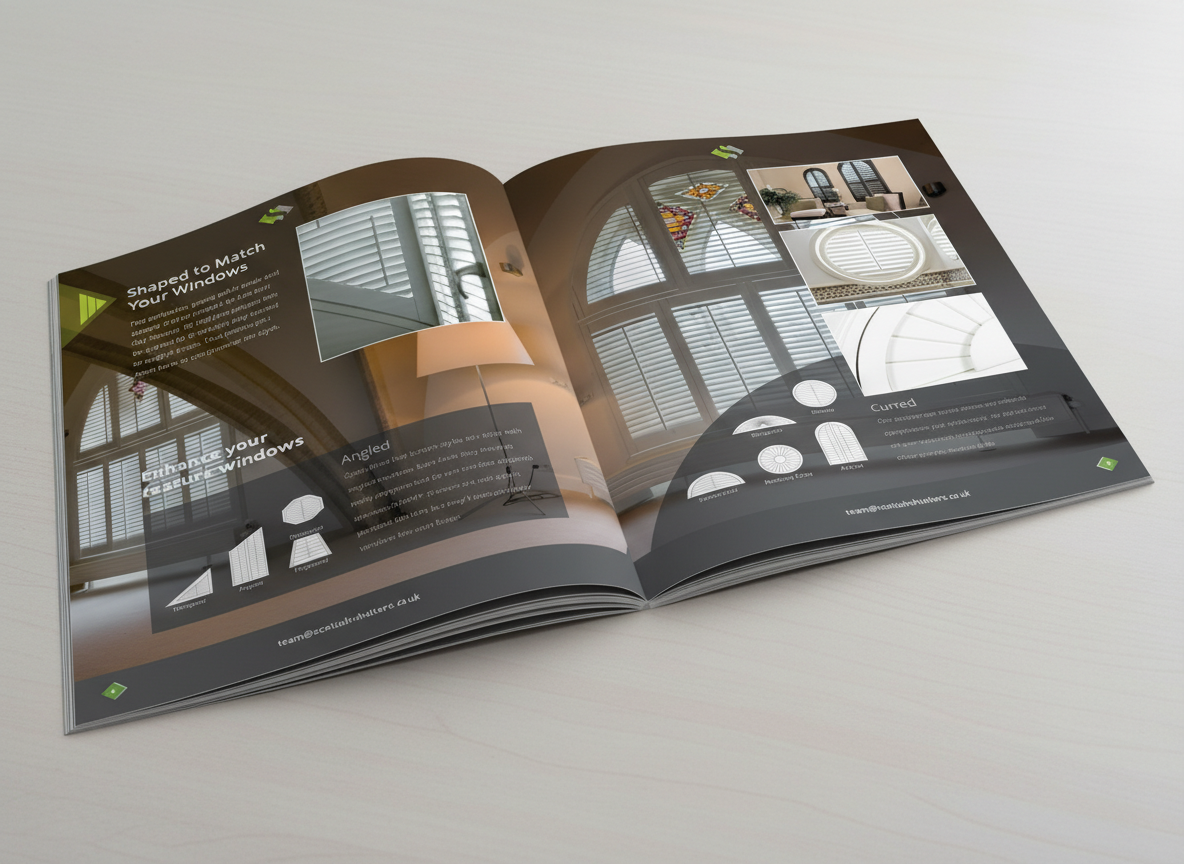
Start with our brochure
52 pages of ideas, product details, and real installations from homes across Scotland. Request your copy and take the first step.