
Honest Comparison
Shutters vs blinds:
which is right for your home?
We install both window shutters and premium blinds, so we have no reason to favour one over the other. This is an honest comparison based on years of installing both products in Scottish homes.
The short answer
Sometimes shutters are better. Sometimes blinds are better. Sometimes you want both in the same house, and sometimes both shutters and blinds on the same window. It depends on the window, the room, and what matters most to you.
Shutters are the stronger choice when you want precise, permanent control over light and privacy, an architectural look that adds value to your home, and something that will last decades with virtually no maintenance. Blinds are the stronger choice when you need superior thermal insulation, near total room darkening for a bedroom, or a solution for an unusual window shape where shutters simply will not work.
The rest of this page breaks that down in detail.
Light control
Shutters give you the most precise control over natural light of any window covering. Tilting the louvres lets you direct light exactly where you want it: up toward the ceiling, down toward the floor, or anywhere in between. You can adjust this throughout the day without ever fully opening or closing the shutter. It is a level of fine tuning that no other product matches.
Blinds approach light control differently. Duette honeycomb blinds with a top down, bottom up mechanism let you lower the blind from the top, keeping the bottom of the window covered for privacy while letting light flood in above. That is something shutters cannot do. Silhouette blinds use soft fabric vanes suspended between two sheer panels, creating a gentle diffused light that is quite different from the crisp directional control of a shutter louvre.
For room darkening, blinds have the edge. A Duette room darkening fabric blocks significantly more light than a closed shutter, because shutter louvres always leave small gaps where light seeps through. If total darkness matters (bedrooms, nurseries, home cinemas), blinds are the better choice.
Privacy
Shutters win on privacy, and it is not close. With the louvres tilted, nobody can see in, but you still get airflow and natural light. This is especially valuable on ground floor rooms facing a pavement or a neighbour's property. The shutter is always there, always working, without you having to think about it.
Most blinds are binary. They are either open (anyone can see in) or closed (you lose your light and view). The exception is Silhouette blinds, which have adjustable vanes that offer a similar tilt function to shutter louvres, giving you privacy with diffused light. But they are a fabric product and do not have the same permanence or structural presence as shutters.
For bathrooms and ground floor rooms where privacy is a daily concern, shutters are the more practical solution.
Insulation and energy efficiency
Duette honeycomb blinds outperform shutters for pure thermal insulation. Their honeycomb cell structure traps air in pockets, creating an insulating barrier that measurably reduces heat loss through windows. In a Scottish winter, that makes a genuine difference to your energy bills.
Shutters provide a solid physical barrier between you and the glass, and they do reduce heat loss compared to bare windows. But they do not have the engineered insulating properties of a honeycomb blind. If energy efficiency is your primary concern, Duette blinds are the better product.
That said, shutters have an advantage in summer. Closed louvres reflect sunlight and reduce solar heat gain, keeping rooms cooler without the need for air conditioning. Blinds tend to absorb heat and transfer it into the room. For year round thermal comfort, both products have their strengths.
Maintenance and longevity
Shutters require almost no maintenance. A wipe with a damp cloth is all it takes. There are no cords to tangle, no fabric to stain, and no mechanisms that wear out with daily use. Quality hardwood shutters last 50 years or more and can be sanded and refinished if you ever want to change the colour.
Blinds are fabric products, and fabric has a finite lifespan. Even premium Duette and Silhouette blinds will typically last 15 to 20 years before the fabric begins to degrade, discolour, or lose its shape. They cannot be refinished. When they reach the end of their life, you replace them entirely.
In kitchens, where grease and steam settle on surfaces, shutters are noticeably easier to keep clean. In bedrooms and living rooms where the environment is gentler, the maintenance difference is less pronounced.
Cost
Shutters cost more upfront. A standard window in our range costs between £544 and £1,592 depending on the material. A premium Duette or Silhouette blind for the same window will typically cost 40 to 60 per cent less.
However, the lifetime picture looks different. A hardwood shutter that lasts 50 years costs less per year than a blind that needs replacing every 15 to 20 years. Over the life of your home, shutters are often the more economical choice. They also add measurable value to your property in a way that blinds generally do not.
If your budget is tight right now, blinds let you dress your windows beautifully at a lower initial outlay. There is nothing wrong with that. You can always add shutters to key rooms later.
Which rooms suit which product
Here is a practical, room by room guide based on what we see working best in our customers' homes.
Living room
Either product works well here. Shutters give a permanent architectural look that transforms the room, and the louvre control is ideal for managing afternoon sun and street level privacy. Silhouette blinds offer a softer, more contemporary feel with their diffused light. If the living room is your showcase room, shutters tend to have the bigger visual impact.
Bedroom
Blinds have the edge here if room darkening matters to you. A Duette room darkening blind blocks significantly more light than a closed shutter. For a nursery or a room where you work night shifts, that can be the deciding factor. If you prefer the look of shutters and can tolerate a little light around the louvres, shutters work perfectly well in bedrooms too.
Bathroom
Our waterproof Java shutters are purpose built for wet environments. They will never warp, swell, or deteriorate in humid conditions. Duette moisture resistant blinds are also a solid option. Both work. Shutters have the advantage of permanent privacy control without needing to operate anything when you walk in.
Kitchen
Shutters are the practical choice in kitchens. Grease and steam settle on every surface near a hob, and a shutter is far easier to wipe clean than a fabric blind. Moisture resistant blinds are an alternative if you prefer the look, but be prepared for more frequent cleaning.
Gable windows and unusual shapes
Motorised cellular blinds are often the only practical option for triangular gable windows, arched transoms, and other unusual shapes. Shaped shutters do exist for some configurations, but the cost premium is substantial and many shapes simply cannot be fitted with shutters. This is one area where blinds are clearly the better solution.
Bay windows
Shutters in a bay window create a striking visual effect. The panels follow the angles of the bay and give the whole area a finished, architectural quality. Blinds work too, but they do not have the same transformative impact.
Conservatory
Blinds are generally the right choice for conservatories. The roof and angled glass panels need specialist blinds (often motorised) to manage heat and glare. Shutters are not suitable for roof glazing. For the vertical windows in a conservatory, either product can work.
Can you use both?
Yes, and many of our customers do. It is one of the most practical approaches.
A common combination is shutters on the main living areas (living room, dining room, kitchen) for the architectural impact and easy maintenance, with Duette room darkening blinds in the bedrooms for better light blocking, and motorised cellular blinds on any gable or shaped windows where shutters are not feasible.
Because we supply and install both products, we can plan a whole house solution that uses the right product for each window. You get a single design consultation, a single installation team, and one company to call if you ever need anything.
Common questions
Are shutters better than blinds?
Neither is universally better. Shutters offer superior longevity, permanent light and privacy control, and an architectural look that adds value to your home. Blinds offer better thermal insulation (Duette honeycomb), superior room darkening for bedrooms, and are often the only option for unusual window shapes like gables. The best choice depends on the room, the window, and what matters most to you.
Do shutters add value to a home?
Yes. Estate agents consistently report that quality window shutters are seen as a permanent home improvement, similar to a new kitchen or bathroom. They appeal to buyers because they are low maintenance, long lasting, and look good from both inside and outside. Blinds are generally seen as a personal choice that a new owner might replace.
Can you have shutters and blinds on the same window?
It is possible but rarely necessary. The more common approach is to use shutters on some windows and blinds on others. For example, shutters on living room and kitchen windows, with Duette blinds on bedroom windows for better room darkening. Many of our customers take this mixed approach.
Are blinds cheaper than shutters?
Yes, blinds generally cost less upfront. A motorised Duette blind for a standard window might cost half to two thirds the price of a shutter for the same window. However, shutters last 50 or more years versus 15 to 20 for blinds, so the lifetime cost can actually be lower with shutters.
Which is better for privacy, shutters or blinds?
Shutters. You can tilt the louvres to block the view from outside while still allowing light and air into the room. With most blinds, you either have them open (no privacy) or closed (no light). The exception is Silhouette blinds, which have adjustable fabric vanes that offer a similar effect to shutter louvres.
What about curtains versus shutters?
Curtains and shutters serve different purposes. Curtains add softness and can provide good room darkening, but they collect dust, need regular washing, and block the full window when closed. Shutters fold neatly to the sides or tilt open, keeping the window clear. Many homes use both together, with shutters for daily light control and curtains for warmth and style.
Which is easier to clean?
Shutters, by a significant margin. A quick wipe with a damp cloth is all they need. Fabric blinds require gentle vacuuming or specialist cleaning. In kitchens where grease and steam are a factor, shutters are noticeably easier to maintain.
Do you install both shutters and blinds?
Yes. We are a Luxaflex Gallery dealer for premium blinds (including Duette, Silhouette, and motorised ranges) and we manufacture and install our own window shutter ranges. Because we install both, we have no reason to push you toward one over the other. We recommend whatever genuinely suits your home.
Last reviewed: by David Browne, Project Director
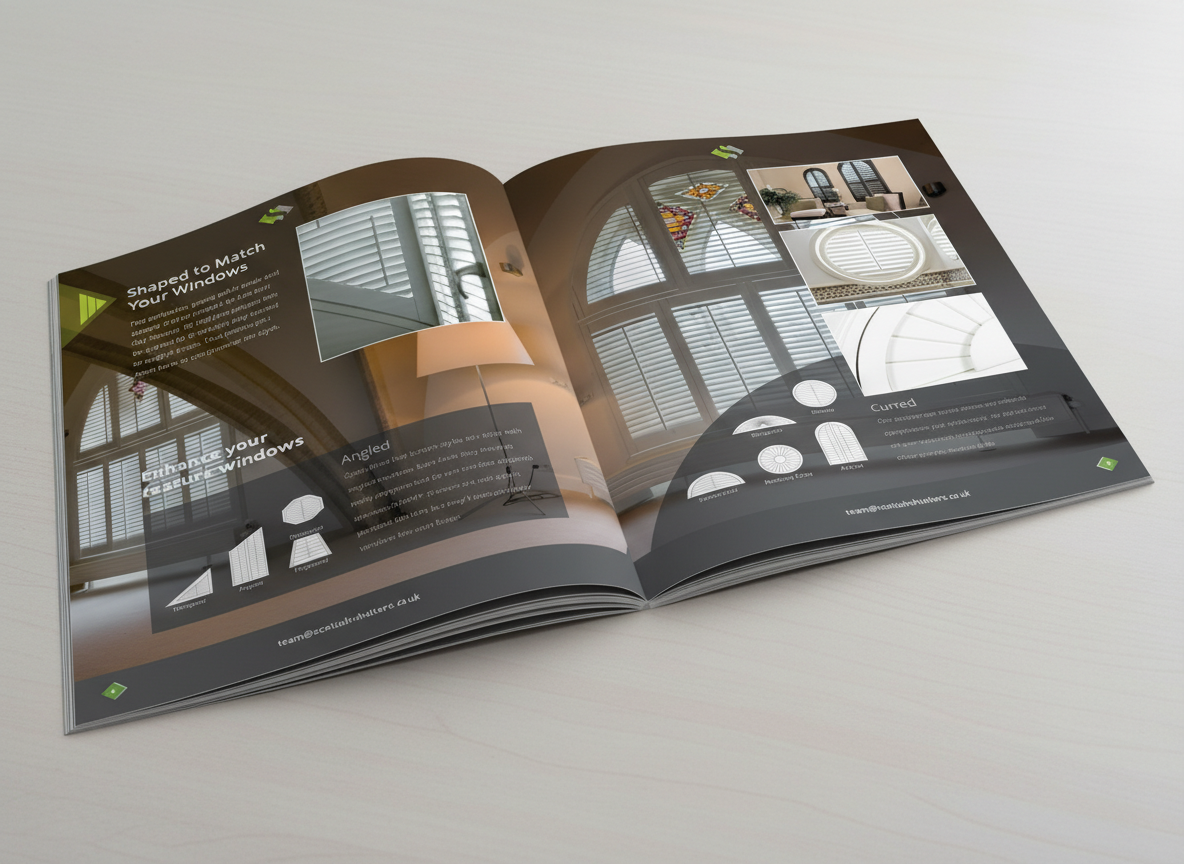
Start with our brochure
52 pages of ideas, product details, and real installations from homes across Scotland. Request your copy and take the first step.