
Honest Advice
The downsides of
window shutters
From a company that sells them. Most companies only talk about the good parts of what they sell. We think that is a mistake. Here are the genuine trade-offs every homeowner should understand before deciding.
Why a shutter company would write this article
Look at almost any website and you will see polished photographs, carefully written marketing language and glowing testimonials. What you will almost never see is a company openly explaining the drawbacks of its own product.
If you are considering shutters for your home, you deserve the full picture. Not just the attractive photographs and the promises. The reality, the compromises and the trade-offs matter just as much.
Shutters can be a wonderful addition to a home. When they suit the window and the property they can transform the look of a room. They provide excellent privacy, good light control and they can last for decades.
But they are not perfect.
In some situations they are not the best option at all. In fact there are plenty of homes where we actively recommend something else.
That may sound strange coming from a company that has been installing shutters across Scotland since 1987, but our philosophy has always been simple. We educate, we do not sell.
If someone installs shutters and later regrets the decision, nobody wins. Not the homeowner and not us. The only way to avoid that is to explain the negatives just as clearly as the positives.
Below you will find the genuine downsides of shutters. Not the softened marketing version. The real considerations that every homeowner should understand before deciding whether shutters are right for their home.
Some of these points may make you reconsider. That is completely fine. If you finish this article feeling informed and confident about your decision, whatever that decision is, then it has done its job.
The genuine downsides of window shutters
They are expensive
The first and most obvious downside is the price.
Shutters are one of the most expensive window coverings you can install in a home. They cost more than curtains, more than most blinds and certainly more than leaving the window bare.
There is no point pretending otherwise.
At The Scottish Shutter Company our ranges currently start from around £544 per window and extend up to about £1,592 depending on the material and design.
| Range | Material | From |
|---|---|---|
| Antigua | Engineered MDF | £544 |
| Bermuda | MDF with ABS louvres | £608 |
| Cuba | Hardwood panels with MDF frame | £646 |
| Fiji | 100% premium hardwood | £768 |
| Java | 100% waterproof ABS | £844 |
| Portchester | Aluminium security | £1,592 |
Those are starting prices for a typical window. Larger windows or more complex panel layouts will cost more.
Once you start installing shutters throughout an entire house the numbers rise quickly. A full property installation commonly falls somewhere between £6,000 and £12,000. In larger homes or properties with many windows the figure can be higher still.
For some households that level of investment makes perfect sense. They view shutters as a long term architectural improvement to the property.
For others it simply does not fit the budget. And that is completely understandable. There are excellent blinds available that cost a fraction of the price and provide very good performance.
See our full pricing breakdown for detailed costs by range and window size.
They take a long time to arrive
Unlike most blinds, shutters are not produced in standard sizes. Every installation is manufactured specifically for the measurements of the windows in that home. The width of each panel, the height of the louvres, the position of hinges and the design of the frame are all tailored to the individual property.
That level of custom manufacturing takes time.
Once an order is placed the shutters must be manufactured and shipped before installation can take place. The normal lead time is between ten and fourteen weeks.
We live in a world where many things can be delivered the next day. Waiting several months for window coverings can feel surprising if you have never ordered shutters before.
There is a faster option through a UK manufacturer that can sometimes deliver in around two weeks. However the selection of finishes and designs is more limited, so it is not suitable for every project.
The reality is that shutters require patience. If you need something quickly, blinds are almost always the faster solution.
They reduce the visible glass area
Shutters introduce structure around a window. A frame sits around the edge of the window opening and panels sit within the recess. Even when the panels are fully open they still take up some of the window area.
This structure is actually one of the reasons people like them. The frames and panels create a sense of order and architectural presence that can make a room feel more finished.
But in smaller windows it can slightly reduce the visible glass area. The room may feel a little more enclosed compared with having nothing on the window or using a slim blind that disappears almost completely when raised.
They do not block light as well as blackout blinds
Shutters are very good at controlling light but they are not designed to produce total darkness.
Light can pass through the small gaps between louvres and around the edges of panels. Even when the louvres are closed tightly some light will still enter the room.
For most living spaces this is not a problem. Many homeowners prefer the soft, filtered light that shutters create.
But in bedrooms where someone wants complete darkness the limitations become more obvious. Parents preparing a nursery sometimes expect shutters to block all light. They can be disappointed when early morning daylight still finds its way into the room.
In those situations a purpose designed room darkening blind will perform better. Luxaflex Duette blinds are a common solution because they are specifically engineered to minimise light entry. They will usually achieve a darker room than shutters ever can.
It is not that shutters are poor at light control. It is simply that blackout is not what they were designed for.
They do not insulate as well as honeycomb blinds
Another area where shutters are sometimes misunderstood is insulation.
Shutters do provide some insulation. Any barrier placed across a window will reduce heat transfer to some extent. But honeycomb blinds such as Luxaflex Duette are specifically engineered for thermal performance.
The fabric of a Duette blind forms a cellular structure that traps air within small pockets. This trapped air creates an insulating layer between the room and the glass. Because of this design, honeycomb blinds provide measurably better insulation than shutters.
If a homeowner's main goal is reducing heat loss or improving energy efficiency, we will often recommend honeycomb blinds over shutters. In some properties the blind will simply perform better.
They can be difficult to operate for some people
Shutters are a manual product. You open and close panels by hand and adjust the louvres to control light and privacy. For most people this becomes second nature quickly.
But on large windows the panels can be substantial. A full height bi-fold panel on a wide bay window requires some physical effort to swing open and fold back. Someone with limited strength or reduced mobility may find this more difficult than they expected.
Adjusting louvres also requires a degree of manual dexterity. Some people with arthritis or similar conditions find the tilting mechanism uncomfortable to use repeatedly.
Motorised shutters do exist and we can supply them, but they add significant cost to the project. For certain homeowners a motorised blind controlled by a remote handset or smartphone is simply easier to live with day to day, and considerably less expensive than motorising shutters.
They are a permanent visual commitment
Shutters become part of the architecture of the room. Once installed, they frame the window and influence the style of the space in a very visible way.
Many homeowners love this. The structured appearance can make a room feel elegant and well finished.
But it also means shutters are not something you change easily. Curtains can be replaced in an afternoon. Blinds can be swapped when you redecorate. Shutters are more like fitted furniture than decoration. Removing them involves unscrewing frames from the window recess and potentially touching up surrounding paintwork.
Not every window suits shutters
Although shutters are versatile there are windows where they are not the best solution.
Very narrow windows can look crowded once a frame and panels are added. There simply is not enough glass to carry the visual weight of the shutter without the whole thing feeling disproportionate.
Certain tilt and turn windows can create practical challenges depending on how the window operates. The shutter panels and the window mechanism need to work together without obstruction, and in some configurations the geometry does not allow it comfortably.
Rooflights and skylights are another area where shutters are rarely suitable. These windows require specialised products designed specifically for sloping or overhead glazing. Motorised lantern blinds are purpose built for these situations.
In many homes we end up installing a mixture of products. Shutters on the main windows, blinds on rooflights, and sometimes external shading for large south facing glass. The goal is always to find the right treatment for each window rather than forcing shutters into every situation.
They need occasional maintenance
Shutters are often described as maintenance free. That is not entirely accurate.
They are certainly low maintenance compared with most other window coverings. But over time, hinges may need adjustment and louvre mechanisms can occasionally stiffen. Painted finishes can chip if struck by furniture or other hard objects. In rare cases a panel may need realigning if the house settles.
Cleaning is normally simple. A wipe with a damp cloth or a pass with a duster is all that is usually required. Compared with fabric blinds that need specialist cleaning or curtains that need washing, shutters remain one of the easiest window coverings to care for. But it would be misleading to claim they require no attention at all.
So when are shutters the right choice?
After reading about all of those drawbacks you might wonder why shutters remain so popular.
The answer is that when they suit a property, they offer a combination of benefits that very few other window coverings can match.
Shutters are right when...
- Longevity matters. A well made hardwood shutter can remain in place for fifty years or more. It can be sanded, repainted, and refinished. Over the life of a home, shutters often work out less expensive than replacing curtains or blinds every ten to fifteen years.
- You want precise light and privacy control. By adjusting the louvres you can allow daylight into the room while blocking the view from outside. No other window covering gives you that same degree of fine control.
- Property value matters. Estate agents consistently report that quality window shutters are seen as a permanent home improvement, in the same category as a new kitchen or bathroom.
- Child safety is a concern. Shutters have no cords, chains, or pull mechanisms. For homes with young children this removes a serious hazard.
- You want an architectural finish. Shutters frame a window in a way that changes how the whole room feels. They add depth, structure, and a sense of permanence.
Shutters are probably not right when...
- Budget is the primary concern. A Luxaflex Duette blind for a standard window can cost less than half the price of a shutter. Blinds will stretch the money further while still providing good performance.
- You need near total darkness. If you are fitting out a nursery, a shift worker's bedroom, or a home cinema room, room darkening Duette blinds will outperform shutters.
- Thermal insulation is the priority. Honeycomb blinds are the better product. The cellular structure traps air more effectively than a shutter panel ever can.
- You are in a short term rental or planning to move soon. Shutters are a long term investment. Blinds or curtains will serve you well in the meantime.
- The window is a rooflight, skylight, or lantern. These need specialised products. Motorised lantern blinds or Duette skylight blinds are purpose built for these situations.
- You like to change things regularly. If redecorating every few years is something you enjoy, the permanence of shutters may feel restrictive.
None of the positives cancel out the downsides listed above. The expense is still real. The lead time is still long. The compromises on blackout and insulation still apply. But for homeowners who value longevity, precise light control, safety, and an architectural finish, shutters deliver something that alternatives simply cannot replicate.
What to do next
At The Scottish Shutter Company we have always believed that good advice matters more than any individual sale.
We do not employ salespeople. We never have and we never will. Every consultation is simply a conversation about what will work best in your home.
Sometimes that conversation leads to shutters. Sometimes it leads to Luxaflex blinds, motorised lantern blinds, awnings, or external shading instead. Because we offer a wide range of products we can focus on finding the right solution rather than pushing a single option.
Our Design Studios in Dundee and Edinburgh are open by appointment only so you receive the full attention of a specialist. We also offer home consultations across Scotland.
If you would like to talk through whether shutters are the right choice for your home, we are happy to help. No pressure. No sales pitch. Just honest advice from people who have been doing this for a long time.
Frequently asked questions about shutter drawbacks
Do shutters make rooms darker?
Shutters can slightly reduce the visible glass area because of their frames and panels. In most homes this effect is minimal, and many homeowners find their rooms actually feel brighter because the painted shutter surfaces reflect and diffuse light around the room. In very small windows with limited glass the reduction is more noticeable.
Can shutters warp or crack?
Quality shutters are engineered to remain stable in normal indoor conditions. Timber shutters should not be installed in wet environments like bathrooms. That is what our waterproof Java range is designed for. Painted surfaces can chip if struck by a hard object, but this is repairable. Warping is extremely rare in properly specified installations.
Are shutters difficult to clean?
Shutters are one of the easiest window coverings to keep clean. Dust can be removed with a soft cloth or duster. Because the surfaces are solid rather than fabric they do not absorb stains, odours, or allergens. They never need washing or specialist cleaning, which is a significant advantage over curtains and fabric blinds.
Do shutters change colour over time?
White painted shutters can develop a very subtle warm tone over many years, particularly in rooms with strong direct sunlight. The process is gradual and most homeowners never notice it. Stained timber shutters tend to remain stable because the finish is absorbed into the wood rather than sitting on the surface.
Can shutters be removed once installed?
Yes. Shutters can be removed by unscrewing the frame from the window recess. However they are designed as a permanent fitted product, so most homeowners leave them in place for the life of the property. If you do remove them you may need to fill screw holes and touch up the surrounding paintwork.
Are shutters noisy in windy weather?
Interior shutters sit inside the window opening, so they are fully protected from wind and weather. Under normal conditions they remain completely silent. If a window is open and a strong draught passes through, louvres may move slightly, but this is rare and easily resolved by adjusting the tilt.
Do shutters affect window ventilation?
Shutters allow good airflow when configured correctly. Panels can be opened fully to expose the entire window, or louvres can be angled to let air pass through while still providing privacy. The adjustability is actually one of the advantages over curtains, which tend to either block airflow completely or provide none at all.
Award Winners 2026
Recognised by the BBSA
The British Blind and Shutter Association recognised The Scottish Shutter Company with three national awards in 2026.
 Best Shutter Installation
  Best Independent Showroom
  Best Marketing Programme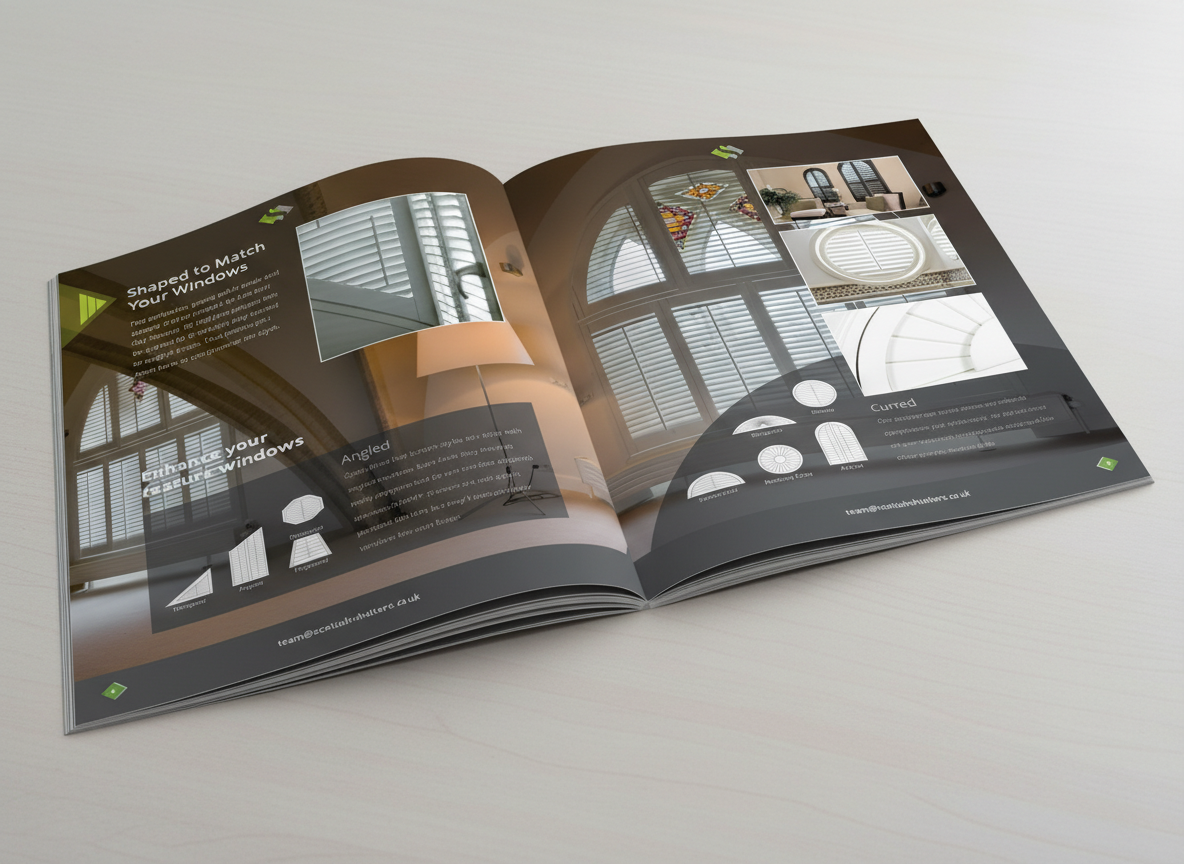
Start with our brochure
52 pages of ideas, product details, and real installations from homes across Scotland. Request your copy and take the first step.